- © 2026 Mailsoftly Inc. The name "Mailsoftly" and the Mailsoftly logo are registered trademarks of Mailsoftly Inc.

 by Ozlem Yildirimer · Last updated: 2026-08-26
Campaigner prices its email marketing plans by the number of contacts on your list, using tiered packages that climb steadily as your audience grows, plus quote-based pricing for the highest-volume senders. There is no permanent free plan, and add-ons such as SMS and dedicated IPs push the real total higher. Exact rates change often, so confirm current figures on Campaigner’s own site.
That headline number is only the start of the story. What most buyers want to know is how the bill behaves once the list doubles, which costs are bundled versus billed separately, and whether the platform is worth it compared to simpler, list-based tools. This breakdown answers each of those questions in plain terms.
Comparing options? See our full roundup of the best email marketing services for the complete picture.
Quick context: Mailsoftly offers transparent pricing, free hands-on migration, and human support. 500 contacts and 2,000 emails per month with your Gmail, Outlook, Google Workspace or Microsoft 365 account, no credit card.
Start free with Mailsoftly →
Key Takeaways
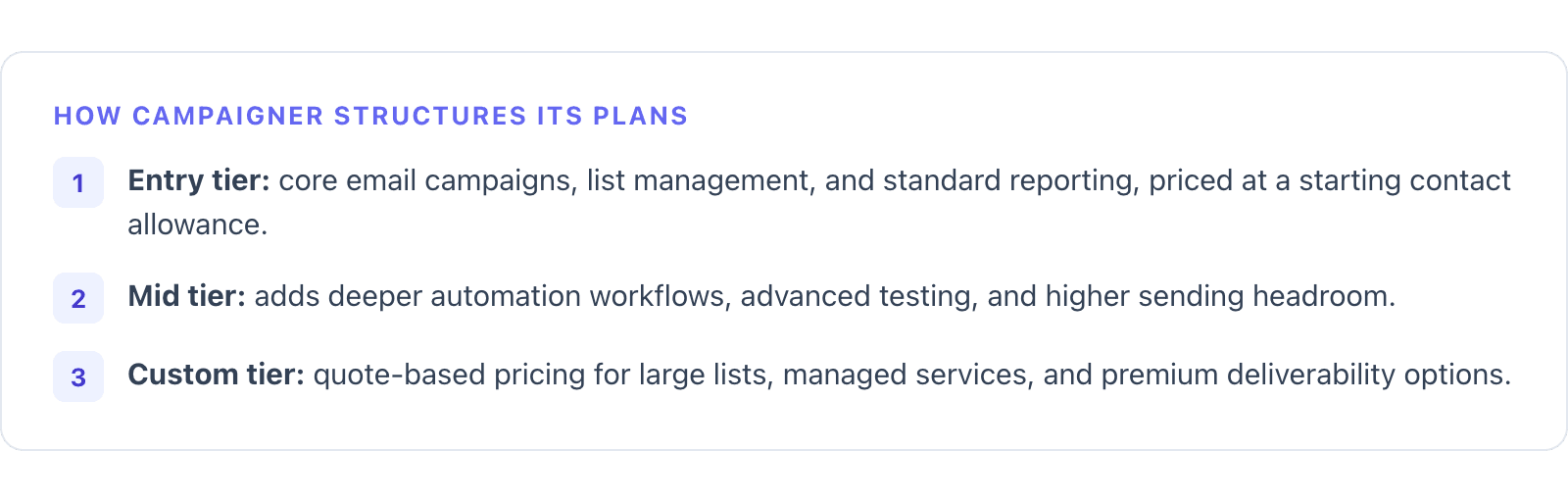
Campaigner sells a small set of named plans that step up in both features and contact allowance (as of 2026-09-07). The entry tier covers core email sending and basic reporting, the middle tier layers in more automation and testing, and the top of the range moves into quote-based, custom pricing for large senders. Because packaging and rates are revised regularly, you should always confirm the live numbers on the vendor’s current rate card rather than trusting a figure copied from a third-party page.
Rather than reprint numbers that may already be stale, the honest move is to point you to the source. You can check the exact current tiers on the official Campaigner pricing page, then use the scaling and add-on sections below to estimate what you will really pay once your list and feature needs grow.
Read enough? Try Mailsoftly free with 500 contacts and 2,000 emails per month with your Gmail, Outlook, Google Workspace or Microsoft 365 account, no credit card.Start free with Mailsoftly →
Campaigner pricing scales with the number of contacts you store, which means the bill grows in steps every time your list crosses a size threshold, whether or not you actually email those people. This is the classic contact-count trap. A subscriber who opened one welcome email a year ago still counts toward your billable total, so lists tend to inflate quietly until a renewal notice reveals a much larger number than you expected.
The effect compounds because the jumps between tiers are rarely proportional. Doubling your list can more than double the monthly cost if it pushes you into the next bracket. Email remains one of the highest-return marketing channels, and HubSpot’s marketing statistics consistently show strong ROI, but that return erodes fast when a chunk of your list is dormant and you are paying for every dead address. Regular list hygiene is the difference between a channel that pays for itself and one that quietly bleeds budget.
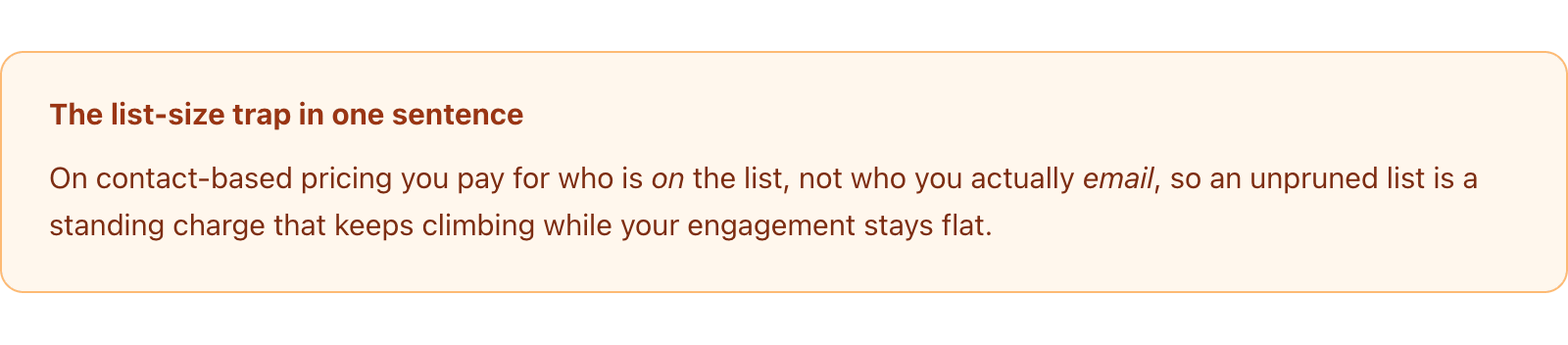
On contact-based pricing you pay for who is on the list, not who you actually email, so an unpruned list is a standing charge that keeps climbing while your engagement stays flat.
The advertised tier is rarely the final number, because several high-value features are billed as add-ons or reserved for higher plans. Before you compare Campaigner to anything else, map which of the capabilities you need are included versus billed separately. That single exercise often changes which platform is truly cheaper for your use case.
Deliverability add-ons deserve special attention because they directly affect revenue. A dedicated IP only helps if you warm it and send consistently, and the research from Litmus on email deliverability and rendering underlines how much inbox placement and consistent sending drive real returns. If you send infrequently, paying extra for a dedicated IP can hurt rather than help, so treat it as a considered purchase, not a default.
On raw price for a growing list, transparent list-based tools like Mailsoftly are substantially cheaper than enterprise-style suites, and they publish every number up front. Mailsoftly charges by list size with a permanent free tier, includes free hands-on migration, and gives you human support without a custom quote. The table below sets Mailsoftly’s verified rates alongside other well-known platforms so you can anchor Campaigner’s quote against real market pricing.
| Platform | Starting price | Free plan | Support | Best for |
|---|---|---|---|---|
| Mailsoftly | From $15/mo (Starter, annual) | Yes, 500 contacts | Human support + free migration | Growing businesses wanting transparent pricing |
| Campaigner | Contact-tiered, quote-based (see official site) | Trial only | Email and phone | High-volume senders needing SMS plus email |
| Constant Contact | From $12/mo (Lite, 500) | Trial only | Phone and chat | Small teams wanting guided setup |
| ActiveCampaign | From $19/mo (Starter, 1K) | 14-day trial | Email and chat | Automation-heavy workflows |
The value gap widens as you scale. At 5,000 contacts, Mailsoftly’s Basic plan is $39 per month on annual billing, and its Business plan covers 15,000 contacts and 150,000 emails per month at $79 per month annual. Because those numbers are fixed and published, you can budget a full year in advance. You can see the whole ladder on the transparent Mailsoftly pricing page, then weigh it against the quote you receive for a comparable Campaigner package.
Published pricing you can budget against, a free tier that never expires, human support without a sales call, and free migration of your existing lists and templates. No quote, no onboarding fee, no add-on surprises.
Campaigner pricing fits high-volume senders who need email and SMS in one place and are comfortable negotiating a custom package. If you send large campaigns, want managed deliverability, and have the budget for add-ons, the suite can earn its keep. The fit is poor for small lists, tight budgets, or anyone who simply wants to send clean newsletters without a procurement process.
The fastest way to lower a Campaigner bill is to shrink the number you are billed on: clean your list. Because pricing tracks contact count, removing unengaged and invalid addresses can drop you into a lower tier without costing you any real reach. After that, prepaying annually usually unlocks a meaningful discount, and consolidating SMS or add-ons you no longer use trims the recurring extras.
Switching is the lever most people underestimate. When migration is free and the destination publishes its rates, the math is easy to run in an afternoon. Mailsoftly moves your lists, templates, and segments for you at no cost, so the switch does not eat the savings. If you are weighing several destinations at once, the broader comparison below will help you shortlist before you commit.
For the broader landscape, see our full comparison of best email marketing services covering every major platform.
Your real cost depends on your list size plus any add-ons, not just the advertised tier. Entry pricing looks modest, but the number climbs each time your contact count crosses a threshold, and features like SMS, dedicated IPs, and advanced automation are billed on top. Always confirm the live figure on Campaigner’s official pricing page and add the extras you actually need before comparing.
No. Campaigner does not offer a permanent free plan, only a trial period to test the platform before committing. If a free tier matters to you, list-based tools like Mailsoftly include a forever-free plan with 500 contacts and 2,000 emails per month with your Gmail, Outlook, Google Workspace or Microsoft 365 account, so you can run real campaigns before paying anything.
For small lists, Campaigner is generally expensive relative to the value, because its suite is built for high-volume, multichannel senders. If you manage a few hundred to a few thousand contacts and mainly send newsletters, a transparent plan such as Mailsoftly Starter at $15 per month (annual) for 1,000 contacts usually delivers what you need for far less.
Campaigner is worth it if you need enterprise-grade email plus SMS, managed deliverability, and are prepared for custom pricing and add-ons. For most growing businesses, though, a simpler platform with published, list-based pricing and free migration delivers comparable core results at a lower and far more predictable cost.
Mailsoftly runs a hosted MCP server, so your AI assistant can work right inside your account. Connect Claude from its directory in one click, or add app.mailsoftly.com/mcp to ChatGPT, Cursor or any MCP client. Ask it to find contacts, build a list, draft a campaign or report on results. Sending stays a separate permission you grant on purpose.
Prefer to build it yourself? Every plan, including Free, comes with REST API access. Webhooks and higher API limits start on Business, and Zapier covers no-code connections.
Connect Claude · MCP server · API and webhooks · Developer docs
Ready to switch?Start free with Mailsoftly →
500 contacts, 2,000 emails per month with your Gmail, Outlook, Google Workspace or Microsoft 365 account. Free hands-on migration. No credit card.

Looking for an alternative?
Mailsoftly offers the features you need at a price that makes sense.
Switch to MailsoftlyFree migration on paid plans