Email Marketing Funnel:
Build a System That Converts
Turn cold subscribers into loyal customers with a stage-by-stage email funnel framework grounded in segmentation, automation, and measurable outcomes.
 by Alkan Balkaya · Last updated: 2026-11-22
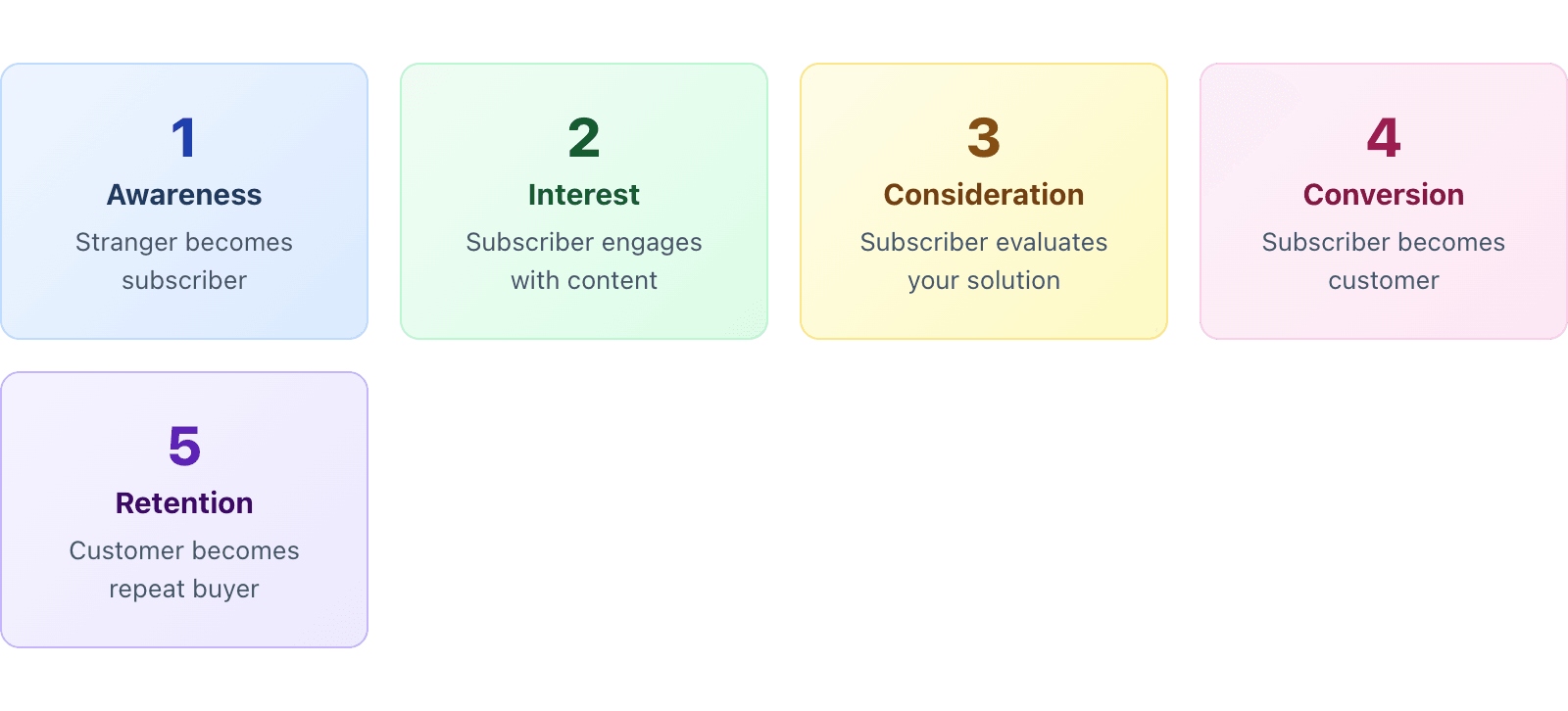
An email marketing funnel is a staged system that maps every subscriber to one of five phases, awareness, interest, consideration, conversion, and retention, then sends the right message at each phase. It replaces random batch sends with behavior-triggered sequences, so engagement rises and revenue becomes forecastable rather than hopeful.
Most email lists leak revenue. Subscribers sign up, receive a few scattered messages, and quietly disengage. The problem is rarely the copy or the offer. It is the absence of structure. This guide walks through each funnel stage, the exact email types that belong in it, the automation logic that ties it together, and the metrics that tell you whether the machine is actually working.
New here? Start with our primer on Email Marketing Fundamentals for the fundamentals, then come back to this guide.
Quick context: Mailsoftly offers transparent pricing, free hands-on migration, and human support. 500 contacts and 2,000 emails per month, no credit card.
Start free with Mailsoftly →
Key Takeaways
The five stages are awareness, interest, consideration, conversion, and retention. A subscriber enters as a stranger, engages with your content, evaluates your solution, becomes a customer, then becomes a repeat buyer. Each stage needs its own email types and triggers. Understanding the arc prevents the most common mistake: treating a day-one subscriber like a returning customer.
Awareness is the entry point. Someone discovers your brand through a blog post, ad, or social media mention and exchanges their email address for a lead magnet or newsletter subscription. At this stage, trust is zero. Your only job is to deliver on the promise that triggered the opt-in.
Interest develops when the subscriber opens emails, clicks links, and consumes your content. They are not shopping yet. They are deciding whether your expertise is worth their attention. Educational content, quick wins, and proof of competence drive this stage forward.
Consideration is where intent sharpens. Subscribers compare options, read case studies, and look for evidence that your product solves their specific problem. Emails here need specificity: feature walkthroughs, comparison guides, and direct answers to objections.
Conversion is the transaction. A free trial signup, a paid plan purchase, or a booked demo. The emails supporting this stage are time-sensitive: limited offers, trial expiration reminders, and clear calls to action with minimal friction.
Retention is where most funnels fall apart. Acquiring the customer cost real money. Keeping them requires onboarding sequences, usage tips, upsell offers, and genuine value beyond the initial sale. According to research from HubSpot’s marketing statistics report, companies that prioritize existing customer engagement see significantly higher revenue growth than those focused solely on acquisition.
Read enough? Try Mailsoftly free with 500 contacts and 2,000 emails per month, no credit card.Start free with Mailsoftly →
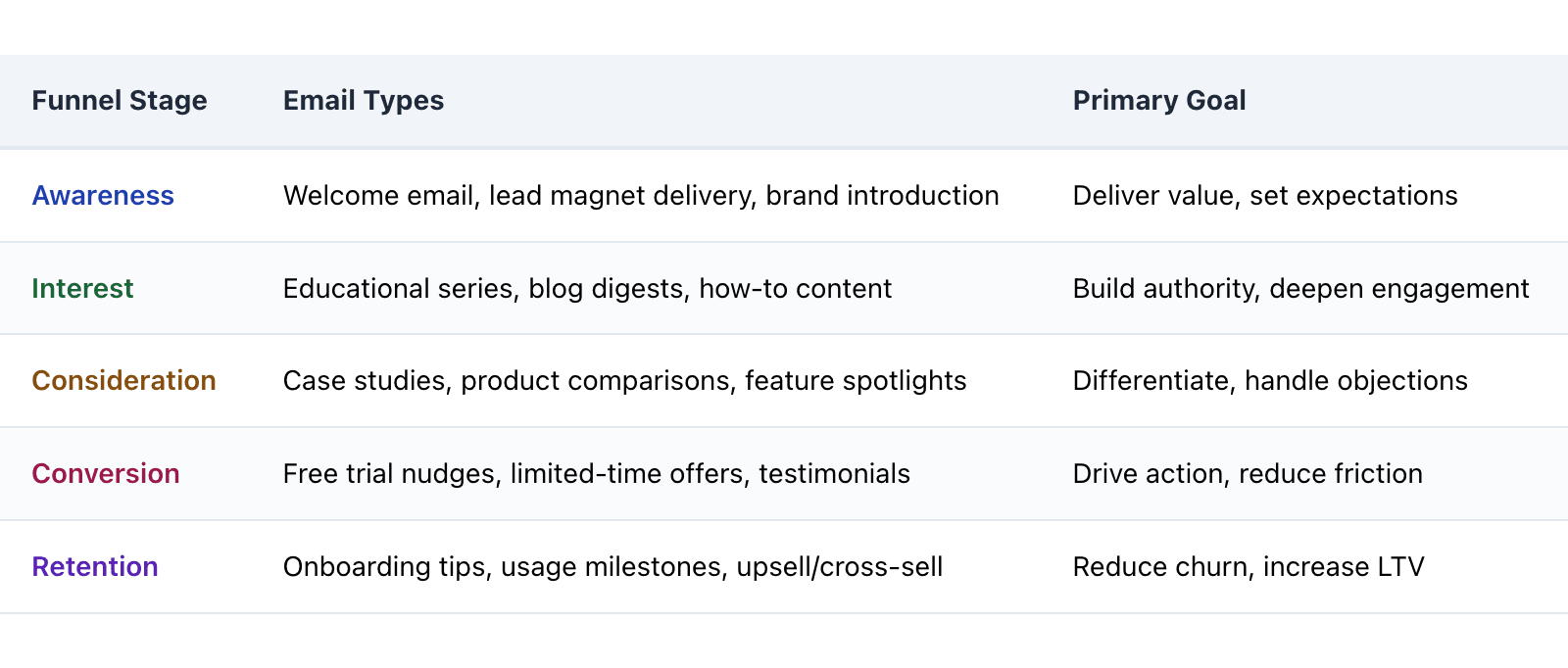
Each stage calls for a different email type: welcome and lead-magnet delivery at awareness, educational series at interest, case studies and comparisons at consideration, offers and testimonials at conversion, and onboarding plus upsell at retention. Sending the wrong type at the wrong stage is worse than sending nothing. A hard-sell to a day-one subscriber trains them to ignore you.
| Funnel Stage | Email Types | Primary Goal |
|---|---|---|
| Awareness | Welcome email, lead magnet delivery, brand introduction | Deliver value, set expectations |
| Interest | Educational series, blog digests, how-to content | Build authority, deepen engagement |
| Consideration | Case studies, product comparisons, feature spotlights | Differentiate, handle objections |
| Conversion | Free trial nudges, limited-time offers, testimonials | Drive action, reduce friction |
| Retention | Onboarding tips, usage milestones, upsell/cross-sell | Reduce churn, increase LTV |
Notice the pattern: emails become more specific and more personal as the subscriber moves down the funnel. Awareness emails can afford to be broad. Conversion emails must feel like they were written for the individual. This progression only works when you segment by funnel stage, which we will cover below.
A complete email sales funnel chains five sequences: a lead magnet that captures the address, a welcome series that builds trust, a nurture track that educates, an offer sequence that converts, and an upsell flow that expands revenue. Each sequence is triggered by the subscriber’s behavior, not a fixed calendar.
Step 1: Lead Magnet. Offer something genuinely useful, a template, checklist, tool, or report, in exchange for an email address. The lead magnet must be closely related to your paid offering. A generic ebook attracts generic subscribers. A specific template attracts people with the exact problem your product solves.
Step 2: Welcome Series (3 to 5 emails over 7 to 10 days). Email one delivers the lead magnet immediately. Email two introduces who you are and why you built the product. Emails three through five provide quick wins, actionable advice that demonstrates your expertise without requiring a purchase. The welcome series is the highest-engagement window you will ever have. Open rates during this period routinely exceed 50%.
Step 3: Nurture Sequence. After the welcome series, subscribers who have not converted enter a nurture track. This is where your email funnel strategy does the heavy lifting. Send one to two emails per week mixing educational content with subtle product references. Every email should answer a question your ideal customer is actually asking. Subscribers who click product-related links get tagged and moved to the consideration stage.
Step 4: Offer Sequence. Once a subscriber has demonstrated intent, visiting a pricing page, clicking a feature comparison, or completing a product tour, trigger a focused offer sequence. Three to five emails over seven days. Each one addresses a different objection: price, complexity, migration effort, or results timeline. Include specific social proof. Vague claims like “thousands of happy customers” convert worse than one concrete testimonial with numbers.
Step 5: Upsell and Expansion. Post-purchase emails are not an afterthought. They are the highest-margin emails in your funnel. A customer who just bought is in peak trust mode. Onboard them well, help them hit their first success milestone, and introduce complementary features or plan upgrades at natural inflection points. Mailsoftly’s email marketing software includes built-in automation for post-purchase sequences that trigger based on actual product usage.
Segment by behavioral signals, not guesses: opt-in recency and low opens for awareness, repeated opens and clicks for interest, pricing-page visits for consideration, trial signups for conversion, and active usage for retention. The funnel is a conceptual model. Segmentation is what makes it operational. Without it, you cannot send stage-appropriate emails. With it, every message lands in context.
The most reliable indicators for each stage:
One critical rule: a subscriber should only belong to one funnel stage at a time. When they cross a threshold, remove them from the previous stage segment and add them to the new one. Overlapping segments lead to duplicate emails, conflicting messaging, and confused subscribers who unsubscribe out of frustration.
According to Litmus research on email marketing ROI, segmented campaigns generate significantly higher revenue per email compared to non-segmented broadcasts. The data confirms what practitioners already know: relevance outperforms volume every time.
Automate each stage with behavioral triggers: a new subscriber fires the welcome series, repeated engagement enrolls them in nurture, a pricing-page visit triggers case studies, a trial start begins the offer sequence, and a purchase launches onboarding. Manual sends cannot maintain this. The volume of triggers, timing constraints, and branching logic make automation a prerequisite, not a luxury.
Awareness Automation. Trigger: new subscriber added to list. Action: send welcome email immediately (within 60 seconds). Enroll in welcome series with pre-set delays. Tag subscriber as “Awareness Stage.”
Interest Automation. Trigger: subscriber opens 3 or more emails or clicks 2 or more links within the welcome series. Action: move to “Interest Stage” segment. Enroll in nurture sequence. Suppress welcome series if incomplete. Start tracking content engagement depth, which topics, which formats, which CTAs get clicks.
Consideration Automation. Trigger: subscriber visits a pricing page, clicks a product feature link, or downloads a comparison asset. Action: move to “Consideration Stage.” Trigger case study delivery. Queue a product demo invitation email after a two-day delay. Notify your team if the account matches a high-value profile.
Conversion Automation. Trigger: subscriber starts a free trial, adds an item to cart, or reaches a custom intent threshold. Action: move to “Conversion Stage.” Begin offer sequence. If no conversion within 7 days, trigger an objection-handling email series. If the trial expires, send a re-engagement offer at day 14 and day 30.
Retention Automation. Trigger: first purchase completed or paid plan activated. Action: move to “Retention Stage.” Start onboarding sequence. Schedule a check-in email at day 7, day 30, and day 60. Monitor product usage. Low-usage customers receive re-engagement emails. High-usage customers receive upsell offers for advanced features or higher plans.
The key principle across all stages: automation handles the mechanics while you focus on the message quality. Review your automated emails quarterly. Update them based on what the data reveals about drop-off points, and test subject lines, send times, and CTAs against each segment individually. Mailsoftly’s pricing plans include automation workflows on every tier (as of 2026-10-18), starting with the free plan that supports 500 contacts and 2,000 emails per month with your Gmail, Outlook, Google Workspace or Microsoft 365 account. The Starter plan is $15 a month (billed yearly, or $19 monthly) for 1,000 contacts and 10,000 emails, and lets you send from your own domain.
Mailsoftly is the strongest fit for growing businesses that want funnel automation without enterprise pricing: it includes automation workflows, stage-based segmentation, and analytics on every plan, starting free with 500 contacts and 2,000 emails per month. Mailchimp, Brevo, and ActiveCampaign are capable alternatives, though pricing and complexity climb faster as your list grows.
| Platform | Funnel Automation | Free Plan | Entry Paid Tier |
|---|---|---|---|
| Mailsoftly | On every plan, including free | 500 contacts, 2,000 emails/mo | $15/mo annual (1,000 contacts) |
| Mailchimp | Limited on lower tiers | Limited contacts, capped sends | Paid, scales with contacts |
| Brevo | Workflows above free limits | Daily send cap (priced by volume) | Paid, scales with email volume |
| ActiveCampaign | Deep, with a steeper learning curve | No permanent free plan | Paid, scales with contacts |
The right choice depends on where your list is today and how fast it is growing. For most growing businesses building a first funnel, a platform that bundles automation, segmentation, and analytics into the free tier removes the biggest barrier: you can prove the model works before you pay for scale. That is why Mailsoftly leads this list for funnel-first teams.
Measure funnel health with stage-specific metrics: opt-in rate at awareness, open and click rate at interest, product visits at consideration, trial-to-paid rate at conversion, and churn at retention. Then layer in stage transition rate and revenue per email. A funnel without measurement is a decoration. These metrics tell you exactly where subscribers stall, drop off, or flow as designed.
| Funnel Stage | Primary Metric | Healthy Benchmark |
|---|---|---|
| Awareness | Opt-in rate / List growth rate | 2% to 5% landing page conversion |
| Interest | Open rate / Click rate | 25%+ open rate, 3%+ CTR |
| Consideration | Product page visits / Demo requests | 15% to 30% of engaged segment |
| Conversion | Trial-to-paid rate / Revenue per email | 10% to 25% trial conversion |
| Retention | Churn rate / Expansion revenue | <5% monthly churn |
Stage transition rate is the metric most marketers miss. It measures the percentage of subscribers who move from one stage to the next within a defined time window. If 1,000 subscribers enter the Interest stage but only 40 reach Consideration within 30 days, your nurture content is not working. Fix the content before adding more top-of-funnel volume.
Time-in-stage reveals bottlenecks. If the average subscriber sits in Consideration for 45 days, your offer sequence needs stronger urgency or better objection handling. If they move from Awareness to Interest in 48 hours, your welcome series is doing its job.
Revenue per email is the ultimate funnel health indicator. Calculate it by dividing total revenue attributed to email by the total number of emails sent in a given period. Track it by stage. Conversion-stage emails should have the highest revenue per send. If retention-stage emails have higher revenue per send, your upsell strategy is outperforming your initial offer, a signal to revisit pricing or packaging.
The most common mistakes are skipping the welcome series, treating all subscribers as one segment, over-automating without review, ignoring retention, and optimizing for vanity metrics. Building the funnel is the first challenge. Maintaining it is the ongoing one. These errors silently degrade performance over time.
Skipping the welcome series. Subscribers who do not receive a welcome email within the first hour are dramatically less likely to engage with future messages. Immediate delivery is non-negotiable.
Treating all subscribers as one segment. Sending a single weekly newsletter to your entire list is not a funnel. It is a broadcast. Broadcasts have their place, but they cannot replace stage-specific messaging.
Over-automating without reviewing. Set-and-forget automation decays. Products evolve, pricing changes, and market conditions shift. Review every automated sequence at least quarterly. Delete or rewrite emails that reference outdated features, expired offers, or old branding.
Ignoring the retention stage. Most email marketing funnels end at conversion. This is a revenue leak. Existing customers are cheaper to sell to, more likely to buy, and more likely to refer. Your post-purchase emails should receive the same strategic attention as your lead generation emails.
Optimizing for vanity metrics. A 40% open rate means nothing if nobody clicks. A high click rate means nothing if nobody converts. Measure what matters at each stage and resist the temptation to optimize a metric that does not move revenue.
For the broader picture on this topic, see our complete Email Marketing Fundamentals guide, which covers strategy, fundamentals, and advanced playbooks.
A complete funnel typically includes 15 to 25 emails across all stages. The welcome series needs 3 to 5 emails, the nurture sequence 5 to 8, the offer sequence 3 to 5, and the retention sequence 4 to 6. Start with fewer emails and expand based on engagement data. More emails are not inherently better, relevance and timing matter more than volume.
You can launch a minimum viable funnel in one to two weeks: a lead magnet, a five-email welcome series, and a basic offer sequence. Expect three to six months of iteration before the funnel is fully optimized. The first version gets data flowing. Subsequent versions improve based on that data.
A drip campaign is a time-based sequence, emails sent at fixed intervals regardless of subscriber behavior. An email marketing funnel is behavior-based. Subscribers move through stages based on their actions, and each stage triggers different content. A drip campaign might be one component within a funnel, but the funnel itself is the larger strategic framework.
Yes. Modern email marketing platforms make funnel automation accessible at every business size. Mailsoftly’s free plan includes automation workflows, segmentation, and analytics for up to 500 contacts and 2,000 emails per month. You do not need enterprise-level tools to run an effective funnel, you need clear stage definitions, relevant content for each stage, and consistent measurement.
Use behavioral data: email engagement (opens, clicks), website activity (page visits, downloads), and product interaction (trial signups, feature usage). Assign tags or scores automatically based on these actions. When a subscriber crosses a predefined threshold, your automation moves them to the next stage. The key is defining clear, measurable criteria for each transition rather than relying on assumptions.
Ready to build your email marketing funnel?Start free with Mailsoftly →
500 contacts, 2,000 emails per month. Free hands-on migration. No credit card.
Ready to boost your email marketing?
Send beautiful, targeted emails that convert. Free plan available, paid plans from $15 a month.
Try Mailsoftly FreeNo credit card required