Healthcare Email Compliance
HIPAA-Compliant Email Marketing Platforms: Which Ones Sign a BAA
The short list of platforms that will put a signed Business Associate Agreement in writing, what each one costs, and what to check before you load patient data.
 by Isabella Torres · Last updated: 2026-11-05
Email marketing platforms that will sign a Business Associate Agreement (BAA) for patient data include Mailsoftly’s Enterprise healthcare setup, Paubox Marketing, and LuxSci Secure Marketing. Constant Contact signs only a standard BAA but bars health information in its Terms, and Mailchimp offers no public BAA. No email software is HIPAA certified; look for a signed BAA plus real controls.
If you manage patient email at a growing practice, the question is not which tool looks nicest. It is which one will put a signed BAA in writing and actually protect protected health information (PHI). Mailsoftly’s Enterprise healthcare setup does both, and below we weigh it against every platform buyers typically shortlist.
New here? Start with our primer on Email Marketing Fundamentals for the fundamentals, then come back to this guide.
Sending to patients? Standard Mailsoftly plans are not for protected health information. Mailsoftly’s Enterprise healthcare setup runs your account in a separate environment with a signed BAA, onboarding, and migration included, from $249/month billed annually.
Contact us about healthcare email →
Key Takeaways
A platform is HIPAA-ready when it will sign a BAA and backs that paper with real controls over how PHI is stored, accessed, and logged. The agreement makes the vendor a liable business associate. The controls are what keep patient data from leaking in day-to-day use. Both have to be present.
This matters because patient data is high-stakes: data breaches in the healthcare sector remain among the most frequent and costly, and a leaked contact list or email log can trigger reporting obligations. Before you move any PHI into a tool, check these five things.
Five HIPAA-ready checks
One blunt fact clears up most confusion: no software is “HIPAA certified.” There is no government certification program for email tools. A vendor that claims to be “HIPAA certified” is using marketing language. The defensible claim is HIPAA-ready or built for HIPAA requirements, paired with a BAA you can actually read and sign.
Handling patient data? The Enterprise healthcare setup is Contact us only, and onboarding typically takes 4 to 6 weeks.Contact us about healthcare email →
Three platforms will sign a BAA for marketing email with PHI: Mailsoftly’s Enterprise healthcare setup, Paubox Marketing, and LuxSci Secure Marketing. Email is still one of the highest-return marketing channels, which is exactly why clinics want to use it, and why the BAA question cannot be skipped. Here is how the three compare.
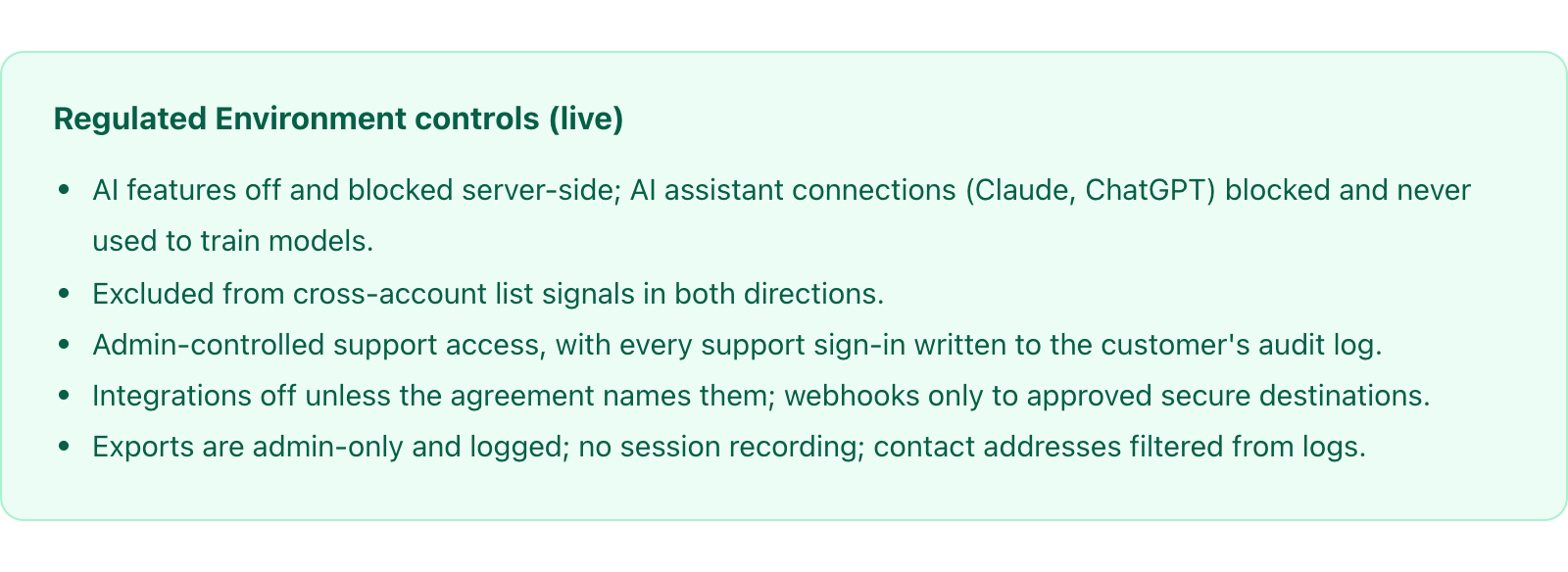
Mailsoftly’s Enterprise healthcare setup is built for HIPAA requirements and includes a signed BAA. The account runs in a separate healthcare environment on Mailsoftly’s Regulated Environment profile, and the BAA is signed once onboarding is complete. Onboarding typically takes 4 to 6 weeks, and migration plus human support are included.
It is Contact us only, with no self-serve signup, and pricing starts at $249 per month billed annually with the BAA and onboarding included. The isolated environment is the point: standard Mailsoftly plans are not for PHI and include no BAA.
Regulated Environment controls (live)
Handling PHI? This is a sales-led setup, not a free signup.
Contact us about healthcare email →Running a general wellness newsletter with no PHI? The free Mailsoftly plan (500 contacts, 2,000 emails per month) is a fine fit there. It simply is not the tool for patient data. For the bigger picture on patient communication, see how email marketing for healthcare works end to end.
Paubox Marketing signs a BAA on all plans, which makes it a genuine option for PHI. It offers a free tier for up to 100 contacts, and the Pro plan starts from $199 per month billed annually (or $259 monthly) for up to 9,999 contacts, with unlimited sending.
Paubox is built around encrypted healthcare email, so compliance is baked into the product rather than bolted on. If you want a self-serve path with a BAA in place from the first plan up, it belongs on your shortlist alongside Mailsoftly.
LuxSci Secure Marketing includes a BAA, so PHI is permitted. Pricing starts from $129 per month for up to 4,999 contacts, and $199 per month for 5,000 to 9,999 contacts. LuxSci leans toward organizations that want granular control over encryption and secure delivery.
It is the most configuration-heavy of the three, which suits larger practices with an IT or security team to tune it. Smaller clinics often prefer a managed setup where the vendor handles isolation and onboarding for them.
Constant Contact and Mailchimp are popular, but neither is built for patient data. Constant Contact will sign only a standard BAA while its Terms bar health information, and Mailchimp does not offer a BAA publicly. Both are fine for general newsletters with no PHI, and unsafe the moment real patient data is involved.
Constant Contact will sign only its standard, non-negotiable BAA, which you request through its legal team. The catch is in its own policy: according to Constant Contact’s Business Associate Agreements article, its Terms prohibit storing or transmitting sensitive personal or health information of any kind, including sensitive PHI, except for subscriber contact information. It also states the services were not built for electronic medical records.
In plain terms: a BAA that exists on paper does not help if the same contract forbids the data you want to send. Use Constant Contact for marketing to contacts you already hold, not for patient care content.
Mailchimp does not offer a BAA publicly, so there is no vendor document that makes PHI permissible. Its rules go further: Mailchimp’s Acceptable Use Policy prohibits uploading sensitive personal information regulated by applicable law, which covers PHI.
That makes Mailchimp a clear no for patient data. It remains a capable tool for non-regulated marketing, but a growing clinic that needs to email about appointments, results, or care should not route PHI through it.
Here is the shortlist side by side, Mailsoftly first. Prices are current as of 2026-10-18, with Paubox and LuxSci figures verified 2026-11-04. The pattern is simple: the three that sign a usable BAA are the three you can consider for PHI.
| Platform | Signs a BAA? | Starting price | Signup model |
|---|---|---|---|
| Mailsoftly (Enterprise healthcare) | Yes, with the Enterprise healthcare setup | From $249/mo billed annually (BAA and onboarding included) | Contact us only |
| Paubox Marketing | Yes, on all plans | Free up to 100 contacts; Pro from $199/mo billed annually | Self-serve and sales |
| LuxSci Secure Marketing | Yes, included | From $129/mo (up to 4,999 contacts) | Self-serve and sales |
| Constant Contact | Standard BAA only; Terms bar health data | Lite from $12/mo at 500 contacts | Self-serve (not for PHI) |
| Mailchimp | No public BAA | Essentials from $13/mo at 500 contacts | Self-serve (not for PHI) |
The cheap self-serve plans look tempting until you read the fine print: Constant Contact and Mailchimp both cost less than a healthcare setup precisely because they are not carrying PHI liability. For patient data, price is not the deciding factor. The signed BAA is.
Before you move patient data into any platform, get clear answers to a short set of questions in writing. If a vendor dodges the BAA question or cannot describe its controls, treat that as a no. Use this checklist on every call.
Vendor questions to ask
When you are ready to load PHI, Mailsoftly’s Enterprise healthcare setup answers all of these in one package: a signed BAA, a separate healthcare environment, logged support access, and an audit trail you can show an auditor. That is the difference between a tool that merely signs paper and one built for the work.
Not legal advice. This guide is informational. Confirm your specific obligations and vendor choice with your own compliance advisor before sending PHI.
For the broader picture on this topic, see our complete Email Marketing Fundamentals guide, which covers strategy, fundamentals, and advanced playbooks.

Yes. If your email contains PHI, the platform acts as a business associate and must sign a BAA before you load that data. Without a signed BAA, sending PHI through the tool is not permitted. Mailsoftly’s Enterprise healthcare setup, Paubox Marketing, and LuxSci Secure Marketing each sign one.
No. There is no HIPAA certification program for software. The accurate term is HIPAA-ready or built for HIPAA requirements. What you should verify is a signed BAA plus real controls, not a certification badge. Any vendor claiming to be “HIPAA certified” is using marketing language.
No. Mailchimp does not offer a BAA publicly, and its Acceptable Use Policy bars sensitive regulated information. Constant Contact will sign only a standard BAA, yet its Terms prohibit health information beyond subscriber contact details. Both are fine for non-PHI newsletters only.
Only if it contains no PHI. The free plan (500 contacts, 2,000 emails per month) suits general wellness newsletters with no patient data and includes no BAA. For any email with PHI, use the Contact-us Enterprise healthcare setup instead.
Onboarding typically takes 4 to 6 weeks, and the BAA is signed once it is complete. The account runs in a separate healthcare environment on Mailsoftly’s Regulated Environment profile, with migration and human support included. Pricing starts at $249 per month billed annually.
Need email that handles patient data?Contact us →
Enterprise healthcare setup with a signed BAA, from $249/month billed annually. Standard and free plans are not for PHI.
Ready to boost your email marketing?
Send beautiful, targeted emails that convert. Free plan available, paid plans from $15 a month.
Try Mailsoftly FreeNo credit card required