by Esma Calis · Last updated: 2026-09-18
The best New Year wishes for business clients and partners are short, sincere, and specific: thank the recipient for the past year, express genuine optimism for the year ahead, and keep the tone warm but professional. Personalize where you can, avoid sales pitches, and send the message before the first working week of January.
A well-timed New Year greeting does quiet, durable work. It reminds a client that you value the relationship, not just the invoice, and it reminds a partner that the collaboration is worth continuing. Done at scale, these messages become one of the easiest goodwill investments on your calendar.
This guide gives you ready-to-send examples for both audiences, a simple structure for writing your own, guidance on timing and format, and a practical way to personalize greetings across a full contact list without losing the human touch.
New here? Start with our primer on Seasonal & Holiday Email Marketing for the fundamentals, then come back to this guide.
Quick context: Mailsoftly offers transparent pricing, free hands-on migration, and human support. 500 contacts and 2,000 emails per month with your Gmail, Outlook, Google Workspace or Microsoft 365 account, no credit card.
Start free with Mailsoftly →
Key Takeaways
The best New Year wishes are warm, brief, and centered on the recipient rather than your company. They acknowledge the relationship, thank the person for their trust or collaboration, and look forward to the year ahead without turning into a promotion. A greeting that reads like a genuine note from one professional to another always outperforms a templated announcement.
Use these copy-ready examples as a starting point. Swap in a first name, a company name, or a shared detail, and each one becomes personal in seconds.
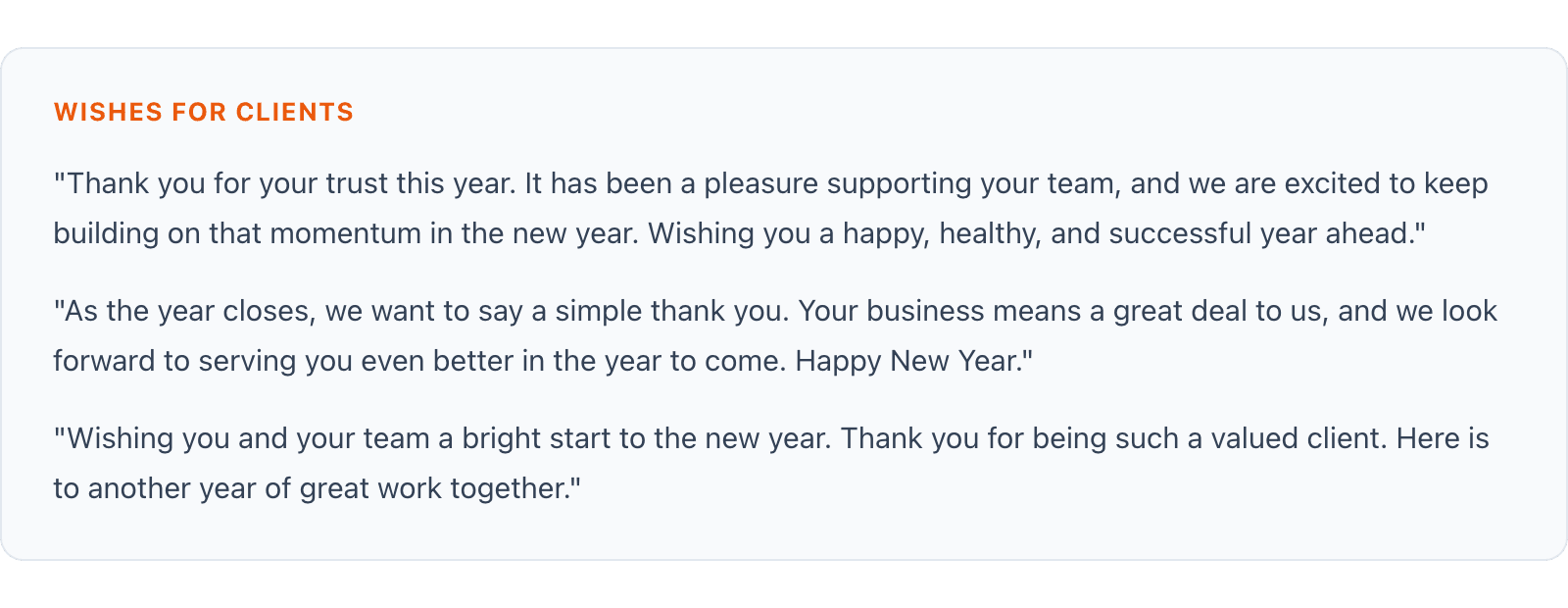
“Thank you for your trust this year. It has been a pleasure supporting your team, and we are excited to keep building on that momentum in the new year. Wishing you a happy, healthy, and successful year ahead.”
“As the year closes, we want to say a simple thank you. Your business means a great deal to us, and we look forward to serving you even better in the year to come. Happy New Year.”
“Wishing you and your team a bright start to the new year. Thank you for being such a valued client. Here is to another year of great work together.”
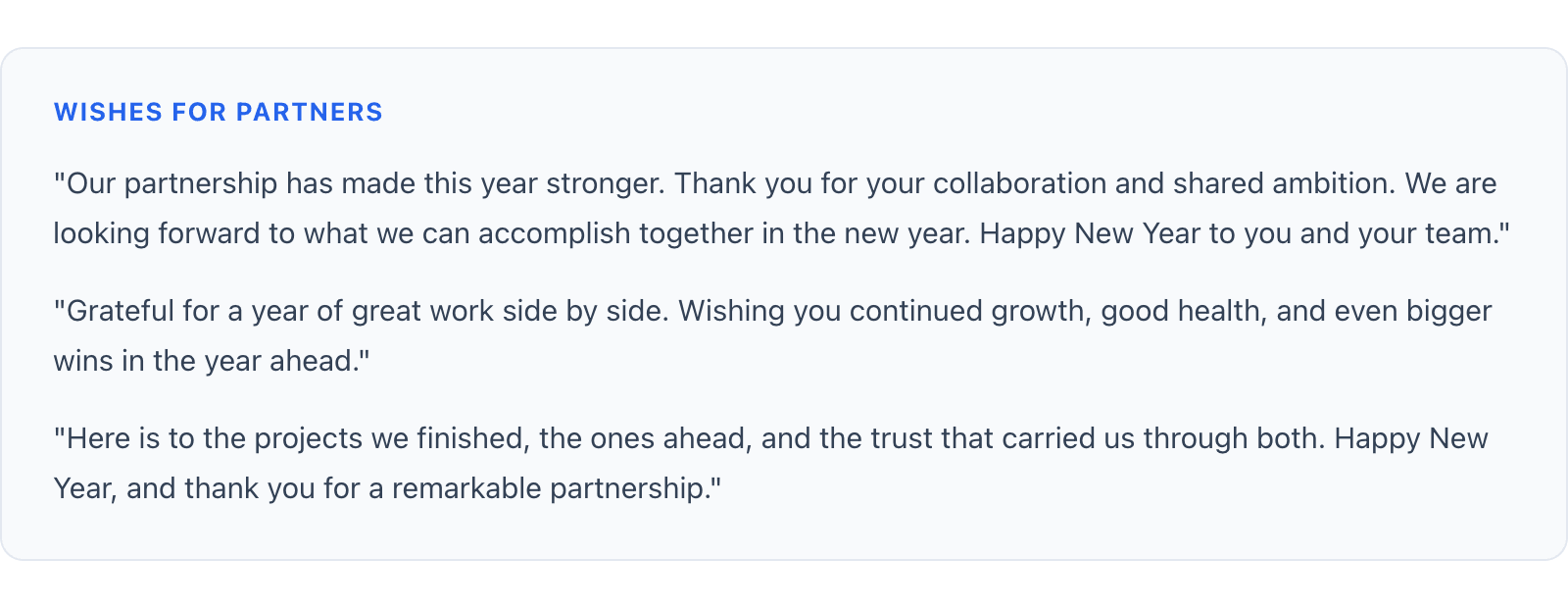
“Our partnership has made this year stronger. Thank you for your collaboration and shared ambition. We are looking forward to what we can accomplish together in the new year. Happy New Year to you and your team.”
“Grateful for a year of great work side by side. Wishing you continued growth, good health, and even bigger wins in the year ahead.”
“Here is to the projects we finished, the ones ahead, and the trust that carried us through both. Happy New Year, and thank you for a remarkable partnership.”
Read enough? Try Mailsoftly free with 500 contacts and 2,000 emails per month with your Gmail, Outlook, Google Workspace or Microsoft 365 account, no credit card.Start free with Mailsoftly →
Write a professional New Year message in four short beats: a warm greeting, a specific thank you, a forward-looking wish, and a friendly sign-off. Keep it to three or four sentences. The goal is to make the recipient feel seen, not to fill space or promote a product.
Follow this structure and almost any greeting will land well:
Avoid three common mistakes. Do not bury a discount code inside a greeting, because it turns a warm note into an ad. Do not use overly formal, stiff language that feels copied from a legal notice. And do not send a wall of text: a New Year wish should be readable in under fifteen seconds.
“Hi [First name], thank you for a wonderful year of working together. Your trust made our best projects possible, and we are grateful for it. Wishing you good health, steady growth, and plenty of wins in the new year. Warm regards, [Your name] and the team.”
Good New Year wishes for business partners emphasize shared achievement and mutual ambition. Where client messages lean on gratitude for trust, partner messages celebrate what you built together and signal your commitment to keep going. The tone can be slightly more familiar, because a partnership implies a two-way relationship.
The strongest partner greetings name a concrete result from the year. Referencing a launched product, a milestone reached, or a difficult project you cleared together makes the message feel earned rather than generic. Even a single specific detail lifts a note above the standard seasonal template.
Email remains one of the highest-return channels for this kind of relationship-building outreach, which is why a thoughtful greeting sent by email so often earns a genuine reply. According to HubSpot’s marketing statistics, email consistently delivers strong engagement and return on investment, making it an ideal medium for warm, low-pressure touches like a New Year wish.
For most businesses, email is the better choice: it is fast, trackable, easy to personalize at scale, and it arrives reliably even when offices are closed for the holidays. A physical card can be a meaningful gesture for a small number of high-value relationships, but email is the practical default for reaching an entire client or partner list.
Email also lets you personalize every message without extra effort. Merge tags insert each recipient’s name automatically, and segmentation lets you send a slightly different note to clients than to partners. That combination of scale and personalization is difficult to match with printed cards.
Email wins on: speed, cost, personalization at scale, delivery timing, and the ability to segment clients and partners.
Cards win on: tactile impact and standing out for a handful of your most important relationships.
A hybrid approach works well for many teams: send a warm email to your full list, and reserve handwritten cards for the few accounts where a personal touch will be most felt. That way you cover everyone while still making key relationships feel special.
Send New Year business greetings between late December and the first working week of January. The two strongest windows are the final days of December, before the holiday lull, and the first two or three business days of January, when inboxes reopen and your message can set a positive tone for the year.
Avoid sending on New Year’s Day itself, when few people check work email, and avoid waiting past the middle of January, when a belated greeting can feel like an afterthought. If you missed the ideal window, a short and honest note that skips the seasonal framing and simply reconnects is better than a late New Year message.
Personalize at scale by combining segmentation with merge fields: group contacts into clients and partners, then use dynamic tags to insert each recipient’s name and company automatically. This lets one carefully written message feel individual to hundreds of people, while still allowing you to tailor the tone for each audience.
An email marketing platform makes this straightforward. With Mailsoftly you can build a client segment and a partner segment, draft a distinct greeting for each, and let merge tags handle the personal details. You can also schedule the send in advance so your greeting goes out at the ideal time even while your team is away.
Mailsoftly’s pricing is transparent and starts free (as of 2026-09-07). The Free plan includes 500 contacts and 2,000 emails per month with your Gmail, Outlook, Google Workspace or Microsoft 365 account, which covers a modest client list at no cost. If your list is larger, the Starter plan is $15 per month on annual billing for 1,000 contacts and 10,000 emails per month, and the Basic plan is $39 per month on annual billing for 5,000 contacts and 40,000 emails per month.
1. Split your list into client and partner segments.
2. Write one warm greeting per segment using the four-beat structure.
3. Add merge tags for first name and company.
4. Send yourself a test and read it aloud.
5. Schedule for late December or the first working day of January.
For the broader picture on this topic, see our complete Seasonal & Holiday Email Marketing guide, which covers strategy, fundamentals, and advanced playbooks.
Write a short note that thanks the client for their trust or business over the past year, then expresses genuine optimism for their success in the year ahead. Keep it to three or four sentences, address them by name, and leave out any sales pitch or discount code.
Yes. New Year wishes are a widely inclusive, secular alternative that suits recipients of any background, which makes them a safe choice for diverse client and partner lists. They also extend your sending window into early January, when inboxes are less crowded.
Keep it professional but warm. Partner relationships are collaborative, so a slightly more familiar tone is appropriate than with a new client. Reference a shared achievement from the year and express commitment to continuing the work together.
You can, but it is better to split your list into at least two segments, clients and partners, and tailor the message to each. Merge tags let you personalize the name and company automatically, so a segmented approach still requires only two pieces of writing.
Aim to send by the first working week of January. After mid-January, a New Year greeting starts to feel belated. If you miss the window, skip the seasonal framing and send a brief note that simply reconnects and looks ahead.
Ready to switch?Start free with Mailsoftly →
500 contacts, 2,000 emails per month with your Gmail, Outlook, Google Workspace or Microsoft 365 account. Free hands-on migration. No credit card.
Ready to boost your email marketing?
Send beautiful, targeted emails that convert. Free plan available, paid plans from $15 a month.
Try Mailsoftly FreeNo credit card required