Turn one-off sessions into a full client pipeline with emails that welcome, nurture, and convert the people who already trust your expertise.
 by Esma Calis · Last updated: 2026-08-31
The best coaching email marketing pairs a small set of proven templates (welcome, consultation offer, program launch, and re-engagement) with three habits: personalize by client goal, keep one clear call to action per email, and send on a predictable rhythm. That combination builds trust, fills your calendar, and turns subscribers into paying clients.
Coaching is a relationship business, and email is the one channel you actually own. Social reach rises and falls with an algorithm, but an inbox is direct. The coaches who win are not the ones who send the most emails. They are the ones who send the right email to the right person at the right moment, using templates they can reuse every week without starting from a blank page.
This guide walks through what makes a coaching email work, the exact templates to keep on hand, and the tactical tips that lift opens, replies, and bookings.
New here? Start with our primer on Email Design & Templates for the fundamentals, then come back to this guide.
Quick context: Mailsoftly offers transparent pricing, free hands-on migration, and human support. 500 contacts and 2,000 emails per month with your Gmail, Outlook, Google Workspace or Microsoft 365 account, no credit card.
Start free with Mailsoftly →
Key Takeaways
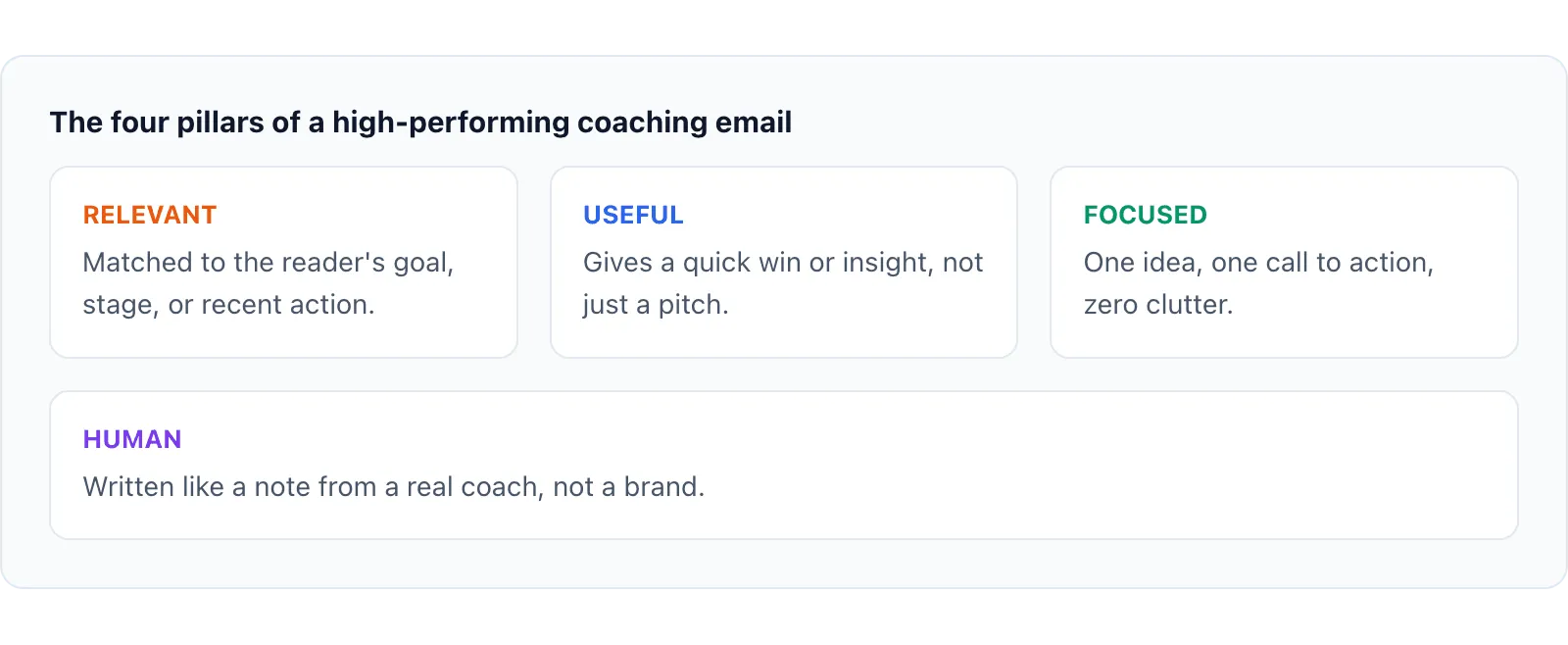
An effective coaching email is personal, focused, and useful before it ever asks for anything. It speaks to one specific goal the reader cares about, delivers a quick win or insight, and ends with a single clear next step. Emails that try to do everything convert no one.
Because coaching sells transformation rather than a physical product, your emails have to prove you understand where the reader is stuck and where they want to be. That is why the strongest coaching emails read like a short, warm note from a mentor, not a broadcast. Research consistently shows email delivers one of the highest returns of any channel, with studies citing roughly a $36 return for every $1 spent on email marketing, and personal, well-targeted messages capture the biggest share of that return.
Strong design supports all four pillars. Clean layout, a readable font size, and a button that stands out make the next step obvious on any device. If you want to go deeper on layout and formatting choices, our Email Design & Templates guide covers the fundamentals that keep coaching emails looking professional in every inbox.
Read enough? Try Mailsoftly free with 500 contacts and 2,000 emails per month with your Gmail, Outlook, Google Workspace or Microsoft 365 account, no credit card.Start free with Mailsoftly →
Every coach should keep a core kit of reusable templates: a welcome email, a free consultation offer, a program or workshop launch, a client success or nurture email, and a re-engagement email for quiet subscribers. With these five ready to personalize, you can run a full email program without writing from scratch each week.
The fastest way to build this kit is to start from proven examples and adapt them to your voice. Our Consulting and Coaching Email Templates Collection gives you a starting library, and you can browse and edit the full set of coaching email templates inside Mailsoftly whenever you are ready to send.
| Template | When to send | Primary goal |
|---|---|---|
| Welcome email | Immediately after signup | Set expectations, build trust |
| Consultation offer | Day 3 to 5 of onboarding | Book a discovery call |
| Program launch | Enrollment windows | Sell a program or workshop |
| Nurture / value | Weekly or biweekly | Teach, stay top of mind |
| Re-engagement | After 60 to 90 quiet days | Win back inactive readers |
You do not have to build these from nothing. Below are proven, editable templates for the most common coaching scenarios. Open the ones that match your niche, swap in your voice and offer, and send.
Write your welcome email to do three things in under 200 words: thank the reader for subscribing, tell them exactly what they will get and how often, and point them to one clear first step. Send it immediately, while your name is still fresh in their mind, because welcome emails earn some of the highest open rates of any message you send.
Keep the tone warm and specific. Skip the corporate greeting and write the way you would speak in a first session. A good structure is a one-line thank you, a short line on who you help and how, a promise of what is coming, and a single call to action such as replying with their biggest challenge or booking an intro call.
“Hi Jordan, thanks for joining. I help mid-career professionals get unstuck and lead with confidence. Every other week I will send one short, practical idea you can use right away. To start: hit reply and tell me the one goal you would love to hit this quarter. I read every message.”
That single reply request does real work. It boosts engagement signals with inbox providers, tells you what your audience actually wants, and opens a one-to-one conversation that often turns into a booked call. When you are ready to send your own version, you can create your free Mailsoftly account and start from a template in minutes.
The best coaching email marketing tips come down to five moves: segment by client goal, personalize beyond the first name, write one focused message with one call to action, prove results with stories, and automate the sequences you repeat. Together they raise opens, replies, and bookings without adding hours to your week.
A career coach and a wellness coach both have subscribers at different stages: cold leads, warm prospects, and active clients. Group them and tailor the message. Targeted segments consistently outperform one-size-fits-all blasts, and thoughtful segmentation can lift open rates by more than 50 percent because each reader gets something that actually fits their situation.
Using a first name is table stakes. Real personalization references the reader’s goal, the resource they downloaded, or the session they attended. “Since you grabbed the burnout checklist” beats “Dear friend” every time. It signals that you are paying attention, which is the entire promise of coaching.
Decide the single action you want before you write a word. Book a call, reply, or claim a spot. Multiple competing buttons split attention and lower clicks. If you have two things to say, send two emails on different days.
Coaching is bought on trust. A two-line client story (“Maria went from dreading Mondays to running her first team offsite”) does more than any list of features. Rotate a short win or testimonial into your nurture emails so social proof shows up naturally.
Your welcome series, consultation follow-ups, and re-engagement flow happen the same way for every subscriber. Build them once as automations so new sign-ups get the right emails on autopilot while you focus on client work.
Most coaches do best sending one email per week or once every two weeks. That cadence is frequent enough to stay top of mind and build trust, but light enough to avoid fatigue and unsubscribes. Consistency matters more than the exact number: a reliable biweekly email beats a sporadic burst of five followed by silence.
Ramp up only around launches. During an enrollment window for a program or workshop, three to five emails across a week or two is normal and expected, as long as each one adds value or urgency. Outside of launches, return to your steady rhythm. Watch your unsubscribe and reply rates as the real signal: if replies stay healthy and opt-outs stay low, your frequency is right.
A predictable schedule also trains your audience to expect and open your emails, which strengthens deliverability over time. Pick a day, pick a rhythm, and protect it the way you protect a client session.
For the broader picture on this topic, see our complete Email Design & Templates guide, which covers strategy, fundamentals, and advanced playbooks.

The best tool is one that is easy to use, has ready coaching templates, and stays affordable as your list grows. Mailsoftly starts free with 500 contacts and 2,000 emails per month with your Gmail, Outlook, Google Workspace or Microsoft 365 account, then scales from $15 per month on the annual Starter plan (as of 2026-09-07), which suits most solo and small-team coaches without the enterprise price tag of heavier platforms.
Three to five emails works well. Start with a warm welcome, follow with a value or story email, then invite the reader to a free consultation. Space them over the first week or two so you build trust before you ask for a call.
No. Simple, mostly text emails that look like a personal note often outperform heavily designed newsletters in coaching. Use clean formatting, a readable font, and one clear button. Reserve richer design for program launches where visuals genuinely help sell the offer.
Ask a direct, easy question and make replying the call to action. End with something like “What is the one goal holding your attention this month?” Replies boost deliverability, tell you what your audience needs, and frequently turn into booked discovery calls.
Start from a proven library rather than a blank screen. Browse the consulting and coaching template set, adapt each to your voice and offer, and send. If you want to launch today, Sign up and use Mailsoftly now and edit a coaching template in minutes.
Ready to switch?Start free with Mailsoftly →
500 contacts, 2,000 emails per month with your Gmail, Outlook, Google Workspace or Microsoft 365 account. Free hands-on migration. No credit card.
Part of: Email Marketing
Ready to boost your email marketing?
Send beautiful, targeted emails that convert. Free plan available, paid plans from $15 a month.
Try Mailsoftly FreeNo credit card required