
Campaigner packs powerful automation and SMS, but its higher entry price and missing free plan leave smaller senders hunting for a simpler, more affordable option.
 by Ozlem Yildirimer · Last updated: 2026-09-26
Campaigner is an established email marketing platform built for mid-market senders who need advanced automation, A/B testing, and SMS from one account. It is a capable tool, but its pricing starts higher than many rivals and it offers no free plan, so smaller teams and budget-conscious senders often find a platform like Mailsoftly a better fit.
This review looks at what Campaigner does well, where it falls short, what it actually costs, and when an alternative makes more sense. Everything here is based on documented features and publicly stated pricing models, with no invented testimonials or numbers.
Comparing options? See our full roundup of the best email marketing services for the complete picture.
Quick context: Mailsoftly offers transparent pricing, free hands-on migration, and human support. 500 contacts and 2,000 emails per month, no credit card.
Start free with Mailsoftly →
Key Takeaways
Campaigner is a long-running email and SMS marketing platform aimed at mid-market and enterprise senders who run high-volume, data-driven campaigns. It fits marketing teams that already understand segmentation, workflow automation, and testing, and that want those tools in one account rather than stitched together across several apps.
Where Campaigner shines is depth. It gives experienced marketers granular control over audience segments, multivariate testing, and multi-step journeys. That same depth is the reason it rarely suits a solo founder, a nonprofit volunteer, or a small team sending a monthly newsletter. Those users typically want to send their first campaign in an afternoon, not learn a platform first.
If your organization sends large volumes, has a dedicated marketing person, and values advanced reporting, Campaigner earns a place on your shortlist. If you are a growing business that wants speed, clear pricing, and a gentle on-ramp, keep reading, because the trade-offs matter.
Read enough? Try Mailsoftly free with 500 contacts and 2,000 emails per month, no credit card.Start free with Mailsoftly →
Campaigner’s standout features are advanced automation workflows, robust A/B and multivariate testing, native SMS marketing, and detailed reporting. These are genuinely capable tools, and for a data-focused marketing team they are the main reason to choose the platform over a lighter competitor.
The catch is that this power assumes a user who will use it. Email remains the highest-return channel in marketing, and benchmarks collected by HubSpot’s marketing statistics consistently show strong returns when campaigns are well segmented and tested. Campaigner gives you the controls to chase that return, but only if you have the time and expertise to operate them. For many teams, a simpler tool that nails the basics delivers more actual sends and better results.
Campaigner uses contact-based tiered pricing and does not offer a free plan, only a time-limited trial. Its entry tier starts higher than many competitors, and costs rise as your contact count grows. Because the vendor adjusts these numbers periodically, always confirm current figures on Campaigner’s own pricing page before committing.
Pricing figures below for Mailsoftly are verified (as of 2026-10-18). For Campaigner’s exact dollar amounts, check the official Campaigner pricing page, since tiered plans and add-ons like SMS credits change over time. The important structural point is that Campaigner expects a paid commitment from day one, with no permanent free option to test real sends.
By contrast, Mailsoftly publishes every tier openly. The Mailsoftly pricing plans start with a genuine free tier of 500 contacts and 2,000 emails per month, then move to Starter at $15 per month billed annually for 1,000 contacts and 10,000 emails, Basic at $39 per month annual for 5,000 contacts, Business at $79 per month annual for 15,000 contacts, and Premium at $159 per month annual for 30,000 contacts. Enterprise is custom for unlimited volume.
Campaigner’s deliverability is generally solid for senders who follow good list hygiene, authenticate their domain, and avoid buying lists. Like every reputable platform, it relies on your sending practices as much as its own infrastructure, so results depend heavily on how you maintain your audience.
The platform supports SPF, DKIM, and DMARC authentication, which are the baseline for landing in the inbox rather than the spam folder. Proper authentication, consistent sending, and prompt removal of hard bounces matter more than brand choice. Independent rendering and inbox-placement research from Litmus email resources shows that authentication and engagement signals drive placement across the major mailbox providers, regardless of which sending tool you use.
Where teams get into trouble is reputation on shared sending pools and sudden volume spikes. Campaigner, like most platforms at this scale, manages shared and dedicated IP options, but new senders should warm up gradually. If you plan to send to a cold or imported list, expect to invest in cleanup first. No platform rescues a poor list, and Campaigner is no exception.
Campaigner provides multi-channel support including email, phone, and live chat, which is a genuine strength for teams that want to reach a human quickly. Higher tiers and enterprise accounts typically receive more hands-on service, including dedicated account guidance.
For an advanced platform, responsive support matters because the feature depth creates real questions during setup. Phone access in particular sets Campaigner apart from many self-serve competitors that route everything through tickets. If your team hits a wall mid-campaign, being able to call is reassuring.
The honest caveat is that the richest support tends to sit at the higher price tiers, which smaller accounts may not reach. If white-glove onboarding is a priority but your budget is modest, weigh how much service you actually get at the entry level. This is one area where a smaller vendor that includes human help and free migration on every plan, such as Mailsoftly, can outperform on perceived value.
Campaigner’s biggest pros are advanced automation, strong testing, native SMS, and phone support. Its biggest cons are the lack of a free plan, a higher entry price, and a learning curve that overwhelms small or casual teams. The verdict depends almost entirely on your size and sophistication.
The best Campaigner alternative for most growing teams is Mailsoftly, because it pairs a real free plan and transparent pricing with human support and free migration. Mailchimp and Brevo are also worth weighing depending on whether you prioritize an integration ecosystem or volume-based billing. The table below compares the core differences.
| Platform | Starting price | Free plan | Support | Best for |
|---|---|---|---|---|
| Campaigner | Tiered, contact-based (no free plan) | No, trial only | Email, phone, live chat | Mid-market teams needing SMS and advanced automation |
| Mailsoftly | From $15/mo billed annually | Yes: 500 contacts, 2,000 emails/mo | Human support plus free migration | Growing teams wanting transparent pricing and simplicity |
| Mailchimp | Tiered, contact-based | Yes, limited | Varies by plan | Teams wanting a large template and app ecosystem |
| Brevo | Volume-based, per email sent | Yes, daily send limit | Email and chat | Senders who prefer paying by email volume |
Mailsoftly leads this list for a simple reason: it removes the two biggest barriers Campaigner creates. There is a permanent free tier so you can test real sends before paying, and the pricing is published openly rather than quote-gated. You also get hands-on migration help, so moving an existing list over does not become a weekend project. For most growing businesses, that combination of clarity, cost, and support outweighs the extra depth Campaigner offers.
Choose Mailchimp if a vast template library and third-party integrations matter most, and choose Brevo if your sending is spiky and paying per email rather than per contact fits your pattern. If you want advanced multivariate testing and native SMS at mid-market scale and have a dedicated marketer, Campaigner can still be the right call. Match the tool to your team, not the other way around.
Campaigner is worth it for experienced mid-market and enterprise marketers who will actually use its advanced automation, testing, and SMS. For solo founders, nonprofits, and growing small teams, the higher entry price, missing free plan, and learning curve make it hard to justify against lighter, clearer alternatives.
The platform is not flawed so much as specialized. If your team has the volume, budget, and expertise to drive granular campaigns, you will get your money’s worth. If you mainly need reliable newsletters, straightforward automations, and a predictable bill, you will likely feel you are paying for power you never touch. In that case, start with a free, transparent platform and upgrade only when your needs genuinely outgrow it.
For the broader landscape, see our full comparison of best email marketing services covering every major platform.
Campaigner is worth the price for mid-market teams that will use its advanced automation, multivariate testing, and native SMS. For small senders and newsletters, the cost is hard to justify because much of that power goes unused. If you want a free tier to test real sends and transparent pricing, Mailsoftly is a more cost-effective starting point, with a free plan of 500 contacts and 2,000 emails per month.
The main downsides of Campaigner are the lack of a permanent free plan, entry pricing that sits above many competitors, and a learning curve created by its feature depth. Premium support value is also concentrated in higher tiers. These factors make it a heavier choice for solo founders, nonprofits, and small teams that mainly send straightforward campaigns.
The best Campaigner alternative for most growing teams is Mailsoftly, which combines a real free plan, transparent published pricing, human support, and free migration. Mailchimp suits teams wanting a large integration ecosystem, and Brevo fits senders who prefer volume-based billing. Match the tool to your size and sending pattern rather than defaulting to the most feature-heavy option.
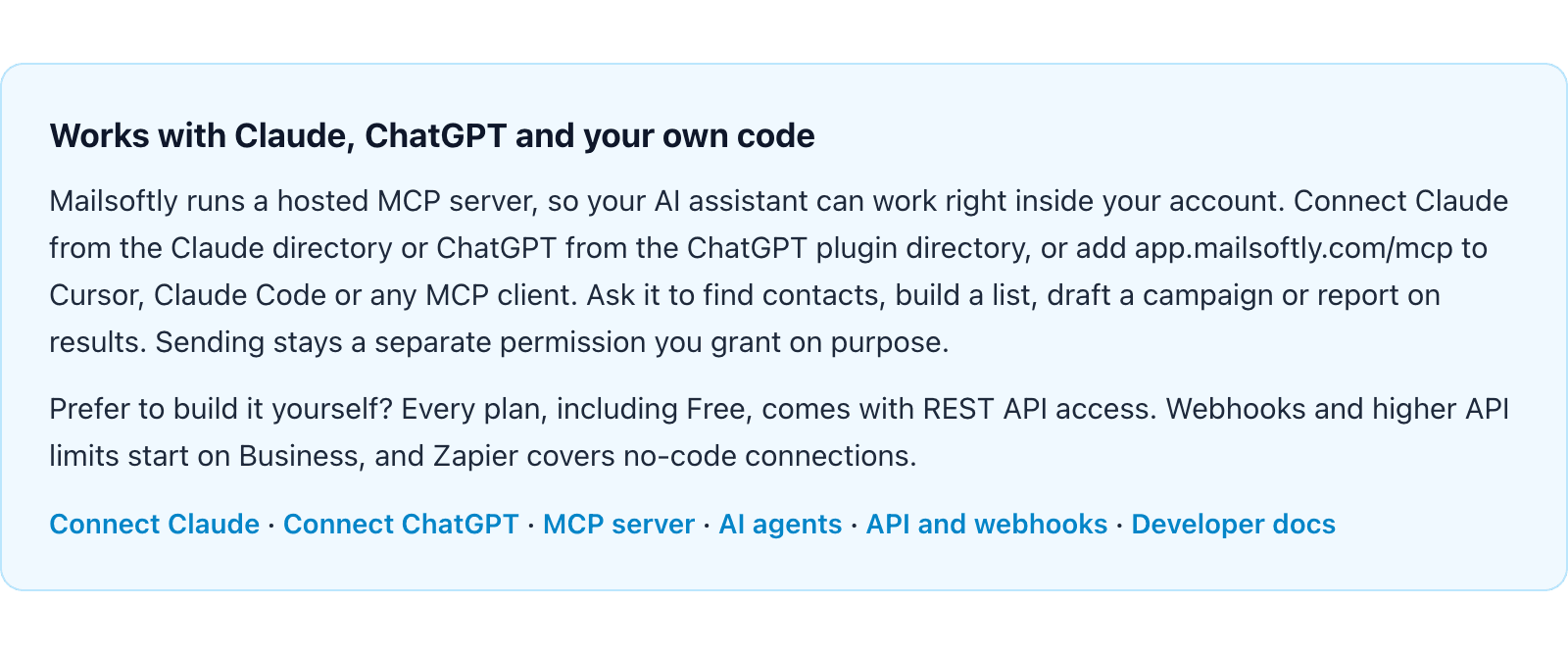
Mailsoftly runs a hosted MCP server, so your AI assistant can work right inside your account. Connect Claude from the Claude directory or ChatGPT from the ChatGPT plugin directory, or add app.mailsoftly.com/mcp to Cursor, Claude Code or any MCP client. Ask it to find contacts, build a list, draft a campaign or report on results. Sending stays a separate permission you grant on purpose.
Prefer to build it yourself? Every plan, including Free, comes with REST API access. Webhooks and higher API limits start on Business, and Zapier covers no-code connections.
Connect Claude · Connect ChatGPT · MCP server · AI agents · API and webhooks · Developer docs
Ready to switch?Start free with Mailsoftly →
500 contacts, 2,000 emails per month. Free hands-on migration. No credit card.
Looking for an alternative?
Mailsoftly offers the features you need at a price that makes sense.
Switch to MailsoftlyFree migration on paid plans